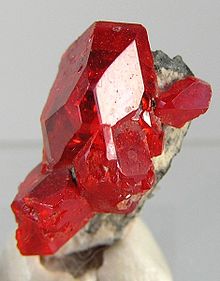
I have just read a lovely message from a reader, who was revisiting Oliver Sacks’ 2005 book Oaxaca Journal, and came across his story of how Sacks always greeted his old friend, chemist and botanist David Emory. They’d had a long and satisfying conversation about arsenic sulphides, with Sacks liking the “euphonious” sulphides orpiment and realgar, which were used for vivid (and poisonous) orange and yellow paints, and Emory loving iron arsenic sulphide, mostly because it’s sometimes called mispickel (which seems to be from the German, with the pickle bit meaning either pick as in a tool or pimple) which he said his students “always took for the name of a sour maiden lady, Miss Pickle”.
From that conversation onwards, he and Emory adopted a regular three-part sulphides greeting.
“He says ‘Orpiment,’ to which I retort, ‘Realgar’ and he caps the trio with ‘Mispickel!’
Saying goodbye went the other way.
So Mispickel.

Orpiment.

Realgar!
 Victoria Finlay
Just read your marvellous “Fabric”. My forebears worked in Dundee jute mills as hecklers and lathe splitters etc. and finished up in mills powered by the Lornty, a tributary of the Ericht which runs through Blairgowrie. My grandfather was, from age 7, a half timer dividing his time between school and the mill. He broke the cycle of poverty by later joining the army- the Gordon Highlanders-fortunately spending most of his time in German captivity. My mother remembers the Dundee workers who were employed as managers in India. Their children were usually schooled privately in the UK, and spoke with an upper class tongue. Their parents retained a Dundee accent, and the mothers were cuttingly referred to as “Calcutta Kates”. It was a wonder to listen to the contrasting voices.