Monthly Archives: April 2024

A story of silk

This afternoon as I investigated the various mysterious folders on my old computer labelled “Miscellaneous” and “to sort” I found a foreword I wrote for the website www.unseenhistories.com to accompany their beautifully designed web version of part of the silk chapter in my 2021 book Fabric. It made me smile to remember thinking of the silk moth I saw in Lyon as my own white rabbit.
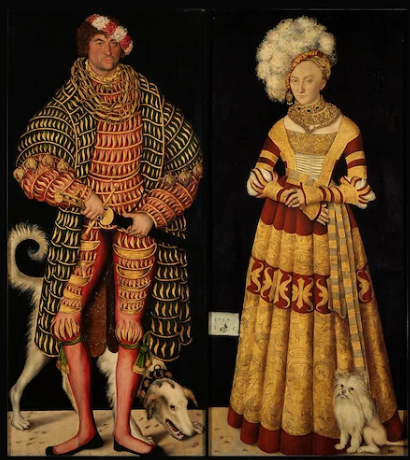
Lucas Cranach’s matching portraits of Henry IV of Saxony and Catherine of Mecklenburg, showing the new fashions both for full length portraits and for clothes cut to show the expensive silk peeking out from underneath.

“When I was writing Fabric, I found myself pushing back the planning of the silk chapter until almost the end. With bark cloth and sackcloth and linen and cotton and the others, there were clear and burning questions in my mind that I was excited to find the answers to. With silk, I was initially less interested in it because it was so obviously luxurious. And having lived in Asia for more than a decade, I had a vague (and as it turned out totally unfounded) feeling that I probably already knew much of what I needed to know. 

But then I went to Lyon, historical centre of France’s silk industry, and I met a silk moth for the first time. It looked like a fluffy white rabbit and like the white rabbit in Alice in Wonderland, it was the moth itself that would be my guide into the rabbit hole of research into, and discovery of, the extraordinary fabric that is silk. In the end it was a journey full of unexpected turns and discoveries. And it was a journey that began where it needed to begin, with a sharp sense of compassion for all the creatures that die to give us silk. 

Fabric is the third in what’s turned out to be a trilogy of books about the histories of small, bright and (usually) lovely materials. And when I was researching each of the books I found doors opening into worlds of history and struggle and beauty and symbolism, and every time it was a surprise.”

The changes writers make

The truth is, if John Le Carre hadn’t decided to drop his original rather plodding first sentence of Tinker Tailor Soldier Spy, (“No one paid much attention when Jim arrived at Thursgood’s: a sandy man with a criss-crossed handsome face”) the beginning of that book might not have been half as well loved as it is. The way that with its absolute directness and energy the original second sentence, now the first (“The truth is, if old [Major] Dover hadn’t dropped dead at Taunton races, Jim would never have come to Thursgood’s at all”) drops us straight into the action; the way we as readers go in a few seconds from not knowing anything about that whole waning spy world of the 1960s that was Le Carrés chosen milieu, to being part of it. There’s a genius there, but it’s rather comforting to see that he didn’t get it right first time.

The corrected typed manuscript of that first Le Carré book is just one of the many treasures of the wonderful Write, Cut, Rewrite exhibition at the Bodleian library in Oxford.

It’s such a small room, and to look at it from the outside you’d imagine that you’d be in and out in half an hour. But we had only one hour and it wasn’t enough. Especially after spending ages poring over the first manuscript, the so-called Ormulum, a 19,000 line 12th century parchment notebook written (and rewritten and crossed out and written again) by a man called Ora, writing in early English about Biblical texts. “It shows someone in mid-thought,” the curators write. “Using a quill and parchment to give shape to their ideas.” It also shows one of the earliest physical examples of editorial cutting and pasting still in existence. And look at that intriguing excised circle on the left hand page!

I wanted to wonder more at Bruce Chatwin’s famous Moleskin notebook (a bit bigger than I’d imagined and with messier handwriting. Or lose myself in George Eliot’s immaculate copperplate in a miniature notebook beside it, making observations from her journey in Italy. Or ponder on the comma removed by Joyce from the first page of A Portrait of the Artist for the second edition in 1917. Or Jenny Joseph’s correction of her much-loved poem “Warning”, with a rather too respectable verse about respectability that was replaced by something much more lively.

And as for Shelley’s Ozymandias. It was written in 1818 as a contest with his fellow poet Horace Smith to write a poem on a random subject (and the one they chose was a passage from Diodorus of Sicily). Once he’d done his corrections to the first draft there was almost nothing left. Except for that famous line: “My name is Ozymandias – King of Kings.”

And a little inspiration that almost all writing, almost all creativity, takes several goes, sometimes many many goes, to make it wonderful.

It’s at the Bodleian until January 2025. And it’s free.